Regional Patterns of Housing and Labour Precariousness across the European Union
Márton Czirfusz (Periféria Policy and Research Center, Budapest, Hungary; czirfusz.marton@periferiakozpont.hu)
Key takeaways
- Patterns of housing and labour precariousness vary widely across regions of the European Union at the NUTS2 level, often reflecting national housing-welfare and labour regimes.
- Regionally specific patterns call for regionally tailored policy responses.
- The housing crisis at the regional level does not equate to an employability crisis or a simple lack of income. Increasing employability or income alone is insufficient to address the current housing crisis.
- EU-wide, fine-grained data on housing and labour precariousness is lacking. Improved data collection is crucial for informing the European Affordable Housing Plan and assessing future policy impacts.
Further reading
The full Chapter 7 of Work Package 3, Deliverable 3.1 can be accessed here:
The full research report of Work Package 3, Deliverable 3.1 can be accessed here:
The complete dataset for this chapter can be accessed here:
Introduction
Work Package 3 of the EqualHouse project explores income, wealth and housing inequalities, and how they intersect. One task within this work package focused on the relationship between housing and labour market inequalities across EU member states, using regional (NUTS2) data. This involved:
- developing a methodology to measure housing and labour precariousness at the regional level across Europe
- identifying regional patterns of housing precariousness and labour precariousness
- creating a typology of regions, based on combinations of housing and labour precariousness
Why regional analysis matters
Policymakers and researchers are increasingly aware of the tensions in regions experiencing economic growth, where employment opportunities are expanding but affordable housing is lacking. In contrast, other regions suffer from depopulation, shrinking public services, and rising vacancies in substandard housing stock.
Within the current housing crisis, the EU’s principle of ‘free’ movement of labour (through which market forces are assumed to balance the supply and demand of housing spatially) and the delegation of housing policy to member states have not sufficiently addressed housing inequalities within and across member states. The current European Commission aims to respond to these challenges. Developing adequate policy responses necessitate solid empirical knowledge, also on how housing and labour precariousness intersect at the regional level.
Measuring labour precariousness and housing precariousness at the regional level
The analysis is based on the premise that housing and labour precariousness co-constitute each other. This means, on one hand, that housing precariousness is shaped by the national institutional contexts of how people work (i.e., national labour regimes), and that the precarisation of employment increases insecurity for households in terms of housing accessibility and affordability. On the other hand, households’ positions in the labour market also determine the conditions in which they live, including housing. While it is often assumed that households facing labour precariousness also experience housing precariousness, the analysis shows this is only partially true.
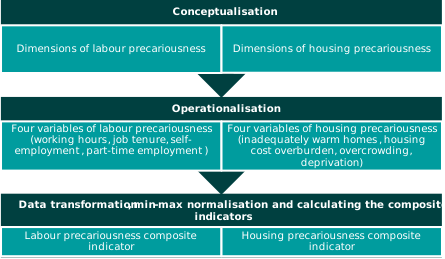
This works builds on existing literature on housing and labour precariousness. Both concepts are treated as multidimensional. Four variables were selected for each, based on academic literature and data availability at the NUTS2 level. A database was constructed, largely using data from 2023. Most data comes from Eurostat, with other sources used to fill gaps.
Composite indicators for labour precariousness and housing precariousness were calculated as unweighted averages of the normalised values of the four initial variables each. These composite indicators range from 0 to 1, with lower values indicating lower levels of precariousness.
Regional patterns of labour precariousness and housing precariousness
The median value of the labour precariousness composite indicator across regions of the European Union is 0.368.
The highest values are observed in the Netherlands and Southern Europe. This reflects high precarious employment in Southern Europe. In the Netherlands, high share of part-time work and short-term employment contracts are linked to labour market flexibilisation. Thus, the nature of precariousness differs due to national contexts, despite similar scores of the composite indicator.
Central and Eastern European countries appear to be the least precarious, largely due to the regulation of formal employment. However, informal employment, often precarious, is widespread in this region and not captured by the labour precariousness composite indicator. Moreover, labour regulation and employment policy may create vulnerabilities and insecurities even within ‘standard’ employment forms. These countries also show relative regional homogeneity.
Social-democratic unitary rental market countries show high labour precariousness indicators, reflecting flexicurity policies. Regional inequalities within countries remain relatively low. Conservative-corporatist unitary rental market countries and North-West European homeownership countries with a dual rental market show moderate values.
The housing precariousness composite indicator shows significant regional variation at the NUTS2 level, with a median value of 0.279.
The highest values are found in some regions of Central and Eastern Europe (e.g., Bulgaria, Romania, eastern Hungary and Slovakia) and in Southern Europe (e.g., parts of Spain and Italy, and all of Greece). Among the 20 regions with the highest levels of precariousness, ten are in Greece. These regions differ if terms of the four initial indicators: Greece is characterised by higher housing cost overburden and overcrowding, pointing to both affordability issues and households’ strategies of intergenerational cohabitation. Romanian regions in the highest precariousness group are marked by overcrowding and deprivation. Bulgarian regions show a combination of overcrowding, deprivation, and the inability to keep homes warm.
The lowest housing precariousness levels are spread across various countries, indicating that low levels are not solely determined by national policy. The 20 lowest-scoring regions span seven countries.
Countries with dual rental markets tend to show the lowest levels of regional housing precariousness, with relatively homogeneous regional patterns. Capital city regions often appear as outliers. Southern European countries (except single-region states) and Central and Eastern European countries show substantial internal inequalities.
A typology of regions
A regional typology was developed using the median values of the composite indicator for labour (0.368) and housing precariousness (0.279) as thresholds to distinguish between low and high precariousness.
Using two categories for the two composite indicators smooths out some of the within-country differences (e.g., regions in Greece with high or very high precariousness). Conversely, in countries where regional scores cluster around the EU-wide median (e.g., Spain), the typology may exaggerate differences. Spain, for example, appears as a patchwork of types, although the actual differences are smaller than the map suggests.
Southern Europe, Eastern Europe and the Baltics are marked by widespread housing precariousness, often combined with labour precariousness (e.g., in Southern Europe and Poland). In these areas, both the housing crisis and the employment crisis need to be addressed through integrated policy solutions.
Labour precariousness without housing precariousness is found in Finland, Sweden, Ireland, and the Netherlands, reflecting flexible labour markets. Northern Italy and much of Austria also fall into this category. In Central and Western Europe, both precariousness indicators are generally below the EU median.
Most member states are regionally variegated. Therefore, national-level policy solutions may be insufficient to address diverse regional challenges. Regions with specific geographic contexts, such as maritime islands and metropolitan areas, often stand out from national averages.
Are housing and labour precariousness patterns interrelated?
Interestingly, there is no significant correlation between regional values of housing and labour precariousness (Pearson correlation coefficient: -0.002, not significant at p < .05).
However, if housing-welfare regimes are considered, two regime groups are observed:
- In conservative-corporatist unitary rental market countries and Southern European countries, labour and housing precariousness are positively correlated. In these two regimes, challenges in labour and housing tend to reinforce each other. Improving one aspect of precariousness could also help alleviate the other
- In the rest of Europe, housing precariousness and labour precariousness are negatively correlated. In these four housing-welfare regimes, reducing labour precariousness is unlikely to address regional housing inequalities on its own